Same discipline. Eight very different obligations.
A ward diet, a shift canteen and a district nutrition programme are governed by different regulations, measured by different authorities and fail in different ways. Below is what actually changes, sector by sector.
- 8 operating environments
- Government to corporate
- Sector-specific SOPs

Industries served, index
The record matters as much as the meal.
Public catering is executed under tender conditions, inspected by authorities and settled against documented beneficiary counts. The operational risk is rarely in the cooking. It is in coverage reporting, statutory records and the ability to reconstruct any given day months later.
- Tender-compliant standard operating procedures issued at mobilisation and audited thereafter.
- Beneficiary reconciliation and coverage reporting in the format the awarding authority requires.
- Statutory labour, licensing and food safety records maintained for inspection without notice.
- Nutrition delivered against prescribed norms and verified by laboratory analysis.
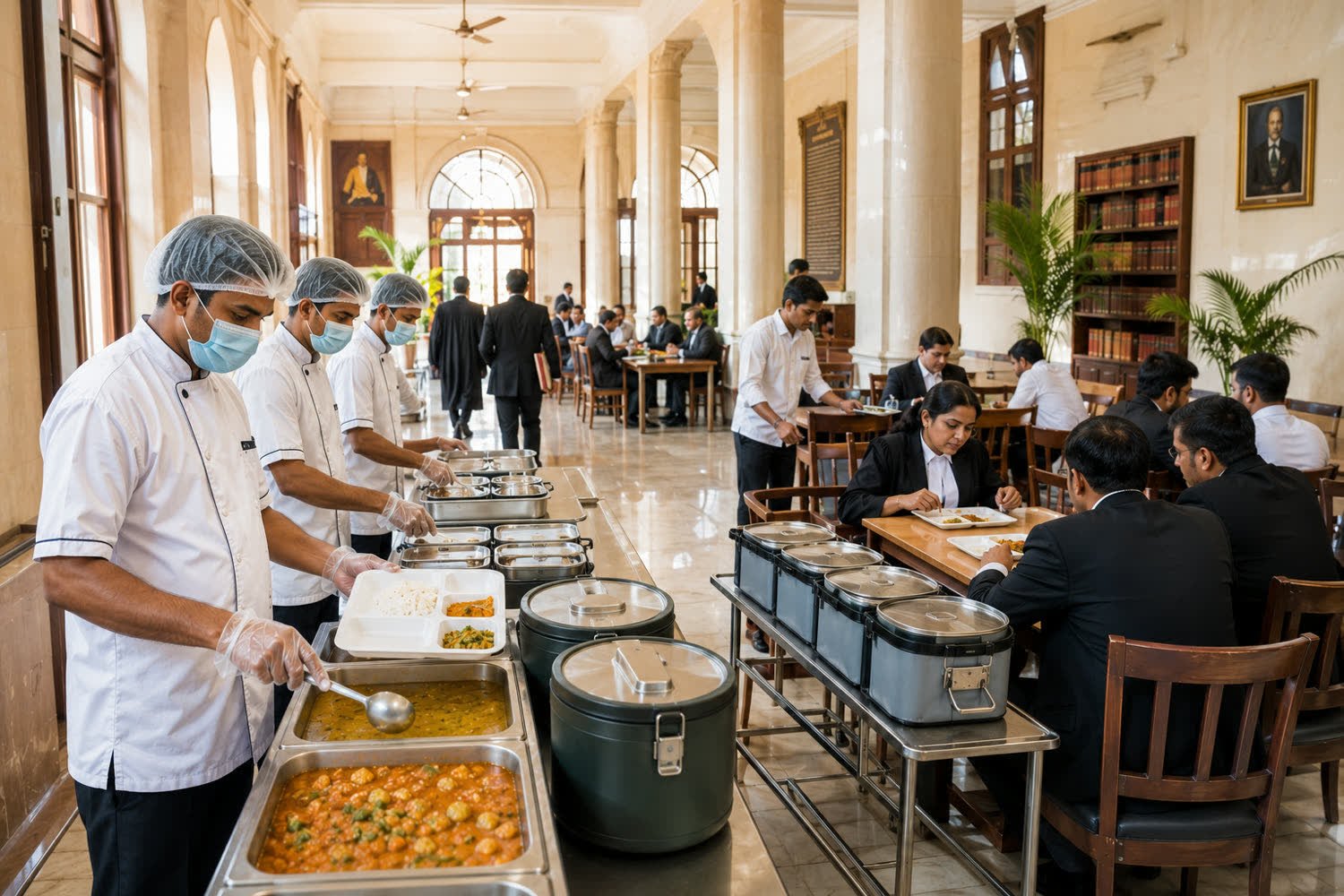
Diet orders are clinical instructions.
Hospital catering carries a patient-safety obligation. A diet order missed, an allergen cross-contacted or a tray delivered to the wrong ward is a clinical incident. Our hospital operations are built around order integrity and infection control before anything else.
- Therapeutic diet production under clinical dietitian supervision, matched to ward diet orders.
- Physically segregated allergen handling with dedicated equipment and cleaning protocols.
- Ward-level distribution with tray identification and temperature verification at delivery.
- Infection control protocols aligned to the hospital's own hygiene and access requirements.

The canteen runs on the plant's clock.
Industrial feeding is a scheduling problem. Shift changes concentrate thousands of people into a fifteen-minute window; a slow counter costs production time. We plan throughput per counter, not just meals per day, and we mobilise to remote sites where no supply chain exists.
- Service windows synchronised to shift rosters, including night and contractor shifts.
- Subsidy, coupon and cashless entitlement systems reconciled to payroll.
- Integration with plant safety induction, PPE and access control regimes.
- Remote-site mobilisation with self-contained kitchen, storage and water treatment.

Fixed timetable, zero tolerance for drift.
Transit and campus feeding share a characteristic: the timetable is immovable and the population is captive. Quality drift is noticed immediately and escalates quickly. Cyclic menus, consumption analytics and a functioning feedback loop are what keep these contracts stable over years rather than months.
- Licensed base kitchen production with sealed-tray packing and traceable batch coding.
- Cyclic menu design reviewed against consumption and wastage data, not assumptions.
- Micronutrient fortification and calorie conformance for school and hostel programmes.
- Structured resident feedback captured, logged and closed within defined timelines.

What each sector is actually measured on.
| Sector | Primary obligation | Typical failure mode we design against |
|---|---|---|
| Government & welfare | Coverage against prescribed norms, fully documented | Incomplete records at audit; unreconciled beneficiary counts |
| PSU & municipal | Continuity of service under statutory compliance | Labour compliance lapses interrupting service |
| Defence & paramilitary | Availability at remote locations, shelf stability | Supply chain breaks at distance from the base kitchen |
| Railways & transit | Batch traceability and cold-chain integrity in transit | Temperature excursion between despatch and service |
| Hospitals | Diet order accuracy and allergen control | Wrong tray to the wrong patient; cross-contact |
| Education | Nutrition conformance and acceptability | Meals that meet the norm but are not eaten |
| Industrial | Throughput inside the shift window | Queue length costing production time |
| Corporate | Consistency of experience across counters and days | Quality drift after the first contract quarter |
Tell us your sector.
Sector-specific capability statements, past-performance records and compliance documentation are available for evaluation.